
A prospective, comparative study of 360 pregnant women with their first physiological pregnancy was conducted. The women were divided into two groups: 180 women aged 22-28 and 180 women aged 36-42. The study aimed to compare the course of pregnancy, frequency of complications, structure of drug therapy, and outcomes of childbirth among somatically healthy women from different age groups. It was found that older women had a statistically significant increase in the incidence of gestational diabetes mellitus (17.2% versus 5.0%), pre-eclampsia (13.9% versus 3.9%), and fetoplacental insufficiency (26.1% versus 8.9%). Additionally, a higher need for medical support was revealed. Progesterone preparations were prescribed to 54.4% of women in the older group compared to 23.3% in the younger group. Antiplatelet agents were also used more frequently in the older group (37.2%) than in the younger group (13.9%). Cesarean delivery rates were higher among the older women, with 44.4% in the older group versus 22.8% in the younger comparison group. The indicators of newborn condition also varied: the Apgar score at 5 minutes <8 points was recorded in 11.7% of babies born to older mothers, compared with 3.3% in the control group. These findings confirm the need for differentiated approaches to managing pregnancies in older women. Despite the increased risks associated with older age, modern obstetric techniques allow for successful management and favorable perinatal outcomes when adequate medical care is provided.
Introduction
Contemporary reproductive medicine and society at large are witnessing a growing trend of an increase in the average age at which women have their first child, and subsequent children (Correa-de-Araujo & Yoon, 2021; ACOG, 2022). This phenomenon, known as "late pregnancy," has attracted intense interest among obstetricians, gynecologists, demographers, and sociologists (Saccone et al., 2022; Sparić et al., 2024). The change in reproductive behavior is driven by complex socioeconomic factors, including women's desire for education, career advancement, and family financial stability, as well as the evolution of traditional family structures (Baklanov et al., 2020; Ye et al., 2023).
Within the context of modern obstetrics, late pregnancy refers to pregnancies in women aged 35 or older. Although this age threshold is arbitrary, statistical evidence supports an increase in certain risks and complications associated with the general process of biological aging and age-related changes in the reproductive system (Attali & Yogev, 2021; Chronopoulou et al., 2021; Frick, 2021).
From a medical perspective, the ideal age for childbearing is between 20 and 30 years old (El Miedany & Palmer, 2021; Racusin et al., 2022). During this period, a woman's body reaches its physiological peak in terms of development, making it the best time for fulfilling its reproductive function. Hormonal balance is optimal, providing a stable foundation for maintaining the menstrual cycle and facilitating fertilization and implantation (Al-Hafez et al., 2020; Romero-Gonzalez et al., 2020; Sabetghadam et al., 2022).
The uterus and other muscular tissues are at their most elastic and toned, contributing to a smooth pregnancy and delivery (Riley et al., 2022; Khadivzadeh et al., 2023). Somatic health is usually free from chronic conditions like hypertension, diabetes, and kidney problems that may worsen or arise during pregnancy (Bischoff et al., 2019; Kitamura et al., 2023; Park & Kim, 2023). Metabolism is active, allowing easy adaptation to the increased demands on the cardiovascular, respiratory, and endocrine systems (Nikolettos et al., 2024).
For a first pregnancy, the optimal age range is 20 to 28 years, minimizing risks for both the mother and the child and providing optimal conditions for fetal development. For subsequent pregnancies, there may be a slight shift in the upper limit; however, the fundamental risks associated with advancing age remain and become more pronounced as one approaches the 35-40 age range (Mate et al., 2021; Bouariu et al., 2022; Chidambaranathan & Culathur, 2022; Flatley et al., 2022).
As women age, a series of natural physiological changes occur in their bodies, directly affecting their reproductive capacity, gestational potential, and the health of their offspring. One of the most significant changes is the decline in ovarian reserve, which refers to the number of eggs in a woman's ovaries (Erel & Ozcivit, 2021; Cavalcante et al., 2023; Pavithra et al., 2023; Bao et al., 2024).
Unlike male germ cells, which undergo continuous renewal throughout life, female oocytes do not regenerate. The number of oocytes is established at birth and decreases irreversibly with each menstrual cycle, especially after the age of 35 (Ding et al., 2022; Li et al., 2022; Perrine et al., 2023). Not only does the quantity of oocytes decrease with age, but their quality also deteriorates, leading to errors in the genetic material (Zhang et al., 2025). These errors can be caused by exposure to adverse environmental factors, chronic illnesses, or the natural processes of cellular aging (Canassa & Baldin, 2022; Han et al., 2024).
The mechanisms responsible for repairing DNA errors in oocytes become less effective with age, increasing the likelihood of chromosomal abnormalities in the developing fetus (Fiorentino & Hughes, 2021). This is the primary cause of the marked increase in the incidence of genetic disorders such as Down syndrome (Wilhelmy et al., 2022; Aprigio et al., 2023). The risk of Down syndrome exponentially increases with age, from approximately 1 in 1,000 for women under 25 years old, to 1 in 350 for those 35 years and older, 1 in 100 in their 40s, and 1 in 30 in those over 45 (Song et al., 2022). In addition to Down syndrome, maternal age is also associated with an increased risk of other chromosomal disorders such as Edwards and Patau syndromes, as well as sex chromosome abnormalities (Macrì et al., 2023; Marçola et al., 2023).
In addition to the potential risks to the developing fetus, the body of a pregnant woman undergoes several changes that can complicate pregnancy. These changes include a decrease in the flexibility of the blood vessels, which can lead to a reduced ability for blood vessels to expand adequately (Castleman et al., 2023). Thus, combined with the increased stress on the cardiovascular system during pregnancy, it can put a woman at risk of developing hypertension and pre-eclampsia. Pre-eclampsia is a serious condition characterized by high blood pressure and protein in the urine (Després et al., 2023; Jordao et al., 2023).
Furthermore, the natural decrease in insulin sensitivity that occurs with age, exacerbated by metabolic changes during pregnancy, significantly increases the likelihood of developing gestational diabetes mellitus (Ye et al., 2022; Lobach et al., 2023). Additionally, the loss of original elasticity in muscle tissue, particularly in the uterine myometrium, can result in uterine weakness and an increased likelihood of requiring surgical intervention during childbirth (Breuking et al., 2023; Bulusu & Cleary, 2023). Moreover, by the time they reach adulthood, many women accumulate a "baggage" of chronic non-reproductive diseases, such as obesity, thyroid and kidney disorders, which tend to worsen during pregnancy and serve as aggravating factors themselves.
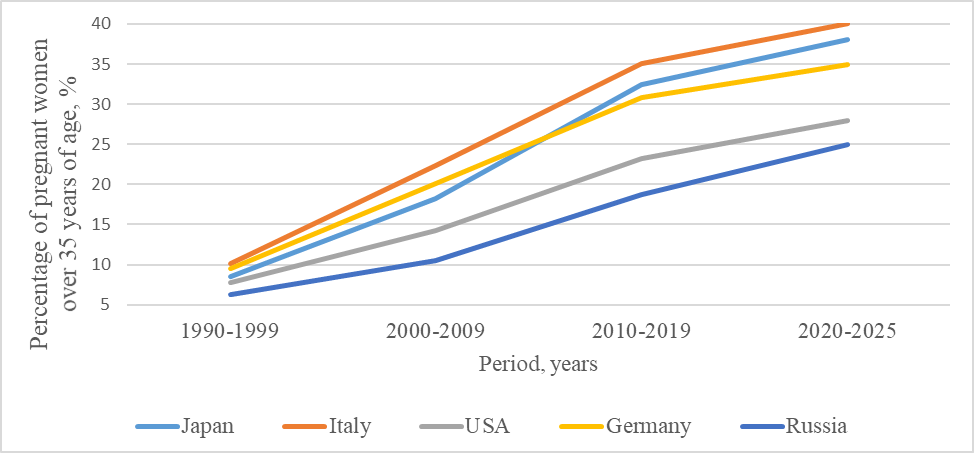
The phenomenon of delayed motherhood, despite its potential risks, has become a global concern. In developed countries around the world, the number of women having children in their late 30s, 40s, and beyond has increased (De Clercq et al., 2023; Shaiba et al., 2024). This trend was relatively uncommon in the early 2000s, but it now accounts for a significant share of the overall birthrate. To better understand this trend, we can examine statistical data from different countries, such as Russia, and compare it (Figure 1).
|
|
|
Figure 1. Dynamics of the frequency of pregnancies and childbirth among women over 35 years of age in different countries of the world and in Russia (in % of the total number of births) |
The data presented clearly show that, although Russia lags behind some countries in southern Europe and East Asia on indicators, there has been a steady increase in the number of late births. This indicates that Russia is approaching global trends in this area. This underscores the importance of conducting in-depth research to develop effective strategies for managing this patient group within the national healthcare system. Recent advances in obstetrics and perinatal medicine have led to significant improvements in outcomes for pregnancies involving older mothers. The development of prenatal diagnostics, the implementation of effective monitoring protocols, and advancements in pharmacotherapy have reduced the risks associated with advancing motherhood.
Particular attention should be paid to the development of pharmaceutical support, as progesterone preparations, antiplatelet agents, tocolytic, and antihypertensive medications can effectively manage many complications commonly seen in older pregnant women. This study aimed to conduct a comparative analysis of first-time physiological pregnancies in two age groups: 22-28 years and 36-42 years, selected based on strict inclusion and exclusion criteria, to assess the course of pregnancy, incidence of complications, prescribed therapies, and outcomes. This study design allows us to separate the effect of age and obtain objective data on current successful pregnancy rates in older women of reproductive age. The results can serve as a basis for developing optimized protocols for managing late pregnancies, taking into account both the risks and the capabilities of modern medicine to minimize them.
Materials and Methods
This study was a prospective, comparative cohort study conducted at Obstetrics and Gynecology centers in Rostov-on-Don from January 2023 to March 2025. The aim was to compare the course of first physiological pregnancies in women in two age groups while excluding the influence of comorbidities.
To achieve this aim, two study groups were created. The control group (group 1) comprised 180 women aged 22–28, with an average age of 25.2±1.9 years, who were experiencing their first physiological pregnancy. The main group (group two) included 180 patients aged 36–42 years with an average of 38.8±2, who were also having their first pregnancy. Both groups met strict inclusion criteria, including:
Additional requirements included euthyroid status and normal glycated hemoglobin levels at enrollment, as well as voluntary informed consent to participate in the study. Exclusion criteria included the development of serious pregnancy complications requiring early delivery, withdrawal from participation, or detection of previously undiagnosed chronic conditions during follow-up. All participants were closely monitored from registration, corresponding to 6-8 weeks of pregnancy, until the end of their pregnancies. The study followed a standardized protocol including clinical and anamnestic examinations, including collecting a complete medical history, monitoring blood pressure, weight, and other anthropometric measurements, and performing laboratory diagnostics focused on the comparative analysis of key parameters.
As part of the complete blood test, special attention was paid to hemoglobin levels to assess the incidence and severity of anemia during pregnancy. Biochemical analysis of blood also included a comparative evaluation of liver function indicators, such as alanine and aspartate transaminases, and kidney function indicators, including creatinine, urea, and a lipid profile at weeks 12 and 30 of pregnancy. The hemostasiogram was used to evaluate coagulation parameters, including fibrinogen, activated partial thromboplastin time, and international normalized ratio, to identify trends toward hypercoagulation. All participants underwent an oral glucose tolerance test with 75 g of glucose at 24-28 weeks to diagnose gestational diabetes mellitus promptly.
Instrumental diagnostics included an ultrasound examination with Dopplerometry, which was performed at standard screening points: 11-14, 18-21, and 30-34 weeks. This study assessed fetometric parameters, placental condition, and blood flow parameters, specifically resistance indices in uterine and umbilical arteries. In the third trimester, all women underwent cardiotocography to comprehensively assess fetal well-being. Statistical analysis was used to compare data from different time points and participant groups. For statistical data analysis, SPSS Statistics 26.0 was used. Quantitative variables following a normal distribution were described using their mean and standard deviation. A t-test was used to compare two independent groups of quantitative variables, and a chi-squared test was used to compare two independent groups of categorical variables. Differences were considered significant if p-values were less than 0.05.
Results and Discussion
A prospective comparative study of 360 patients with the first physiological pregnancy revealed statistically significant differences in the course of the gestational period, the nature of complications, management tactics, and pregnancy outcomes between age groups.
1. Gestational complications and hospitalization rates (Table 1). Analysis of the frequency and structure of obstetric complications demonstrated pronounced age-associated differences. In the group of women of older reproductive age, complications requiring medical correction and inpatient treatment were significantly more common.
Table 1. Comparative analysis of pregnancy complications and hospitalization rates
|
Parameter |
Group 1 (22-28 years) n=180 |
Group 2 (36-42 years) n=180 |
P-value |
|
Gestational diabetes mellitus |
9 (5.0%) |
31 (17.2%) |
<0.001 |
|
Pre-eclampsia |
7 (3.9%) |
25 (13.9%) |
0.001 |
|
Fetoplacental insufficiency |
16 (8.9%) |
47 (26.1%) |
<0.001 |
|
Threatened miscarriage |
35 (19.4%) |
62 (34.4%) |
0.002 |
|
Second half of pregnancy gestosis |
8 (4.4%) |
36 (20.0%) |
<0.001 |
|
Uterine hypertonus |
51 (28.3%) |
82 (45.6%) |
0.001 |
|
First and second trimester bleeding |
8 (4.4%) |
15 (8.3%) |
0.125 |
|
Early toxemia (severe form) |
14 (7.8%) |
23 (12.8%) |
0.121 |
|
Average number of hospitalizations |
1.2 ± 0.4 |
2.8 ± 0.9 |
<0.001 |
|
Total duration of hospitalization, days |
12.3 ± 3.1 |
24.6 ± 7.8 |
2. Features of drug therapy (Table 2). The structure of the prescribed therapy reflected a higher need for medical pregnancy support in the group of women aged 36-42 years. Statistically significant differences were noted in the frequency of prescribing drugs to preserve pregnancy and correct placental insufficiency.
Table 2. Comparative analysis of the frequency of prescribing medications
|
Therapeutic Group / Drug |
Group 1 (22-28 years) n=180 |
Group 2 (36-42 years) n=180 |
P-value |
|
Hormonal support (progesterone) |
42 (23.3%) |
98 (54.4%) |
<0.001 |
|
Tocolytics (hexoprenaline) |
38 (21.1%) |
79 (43.9%) |
<0.001 |
|
Antiplatelet agents (dipyridamole) |
25 (13.9%) |
67 (37.2%) |
<0.001 |
|
Antispasmodics (drotaverine) |
89 (49.4%) |
124 (68.9%) |
<0.001 |
|
Antihypertensive drugs |
6 (3.3%) |
28 (15.6%) |
<0.001 |
|
Iron supplements |
145 (80.6%) |
152 (84.4%) |
0.332 |
3. Delivery outcomes and delivery methods (Table 3). The analysis of the final stage of gestation revealed significant differences in labor characteristics and the frequency of surgical delivery. In the main group, there was a high incidence of labor anomalies and complications during childbirth.
Table 3. Complications in childbirth and methods of delivery
|
Parameter |
Group 1 (22-28 years) n=180 |
Group 2 (36-42 years) n=180 |
P-value |
|
Spontaneous vaginal delivery |
139 (77.2%) |
100 (55.6%) |
<0.001 |
|
Cesarean section |
41 (22.8%) |
80 (44.4%) |
<0.001 |
|
Uterine dysfunction |
21 (11.7%) |
58 (32.2%) |
<0.001 |
|
Labor induction with oxytocin |
25 (13.9%) |
64 (35.6%) |
<0.001 |
|
Timely rupture of membranes |
152 (84.4%) |
126 (70.0%) |
0.001 |
|
Blood loss > 500 ml |
9 (5.0%) |
23 (12.8%) |
0.009 |
|
Preterm delivery (< 37 weeks) |
8 (4.4%) |
19 (10.6%) |
0.024 |
4. Indicators of the condition of newborns (Table 4). Evaluation of the parameters of newborns demonstrated the presence of certain differences between the groups. Despite the absence of a clinically significant difference in the average weight of full-term infants, a large proportion of newborns with signs of hypoxia were observed in the group of older mothers.
Table 4. Anthropometric indicators and assessment of the condition of newborns
|
Parameter |
Group 1 (22-28 years) n=180 |
Group 2 (36-42 years) n=180 |
P-value |
|
Mean gestational age at delivery, weeks |
39.2 ± 1.1 |
38.5 ± 1.8 |
0.003 |
|
Mean birth weight, g |
3380 ± 420 |
3450 ± 510 |
0.154 |
|
Low birth weight (< 2500 g) |
5 (2.8%) |
12 (6.7%) |
0.073 |
|
Macrosomia (> 4000 g) |
11 (6.1%) |
22 (12.2%) |
0.042 |
|
Apgar score at 5 minutes < 8 |
6 (3.3%) |
21 (11.7%) |
0.003 |
5. Laboratory and instrumental markers (Table 5). For an in-depth understanding of the pathogenesis of complications, an analysis of key laboratory and Dopplerometric parameters in the dynamics of pregnancy was carried out. Statistically significant differences were revealed, reflecting more pronounced metabolic and vascular changes in patients of the older age group.
Table 5. Dynamics of laboratory and instrumental indicators
|
Parameter |
Gestational Age |
Group 1 (22-28 years) n=180 |
Group 2 (36-42 years) n=180 |
P-value |
|
Fibrinogen, g/L |
12 weeks |
3.8 ± 0.5 |
3.9 ± 0.6 |
0.285 |
|
Fibrinogen, g/L |
30 weeks |
4.5 ± 0.6 |
5.1 ± 0.7 |
<0.001 |
|
Total Cholesterol, mmol/L |
12 weeks |
4.9 ± 0.8 |
5.0 ± 0.9 |
0.451 |
|
Total Cholesterol, mmol/L |
30 weeks |
6.8 ± 1.0 |
7.6 ± 1.2 |
<0.001 |
|
Uterine Artery Resistance Index |
21 weeks |
0.52 ± 0.07 |
0.61 ± 0.09 |
<0.001 |
|
Uterine Artery Resistance Index |
32 weeks |
0.48 ± 0.06 |
0.56 ± 0.08 |
<0.001 |
An analysis of the results leads us to conclude that, first pregnancies in women over 35 years old, even without initial medical conditions, are associated with a significantly increased risk of obstetric complications. These pregnancies require increased medical support and often result in hospitalizations as well as surgical deliveries.
The findings regarding metabolic and vascular changes suggest a need for specialized protocols for this patient group. The study demonstrates the complex impact of age on first pregnancies, reflected in a significant increase in obstetrical complications, increased medical care requirements, and changes in delivery methods for older women (Schmitz et al., 2022; Rial-Crestelo et al., 2024).
The data obtained are consistent with the findings of large-scale international studies, which confirm that maternal age is a risk factor for the development of gestational diabetes, pre-eclampsia, and placental insufficiency (Peteiro-Mahia et al., 2022; Nan et al., 2023; Carducci & Izbizky, 2024). Revealed deterioration in uteroplacental blood flow, along with more pronounced changes in hemostatic and lipid metabolism systems in patients aged 36-42, provides a pathogenetic basis for these clinical findings (Escudero Quispe & Vivanco Osorio, 2025). An increase in fibrinogen and cholesterol levels in the third trimester suggests increased stress on adaptive mechanisms, creating a basis for vascular complications in the main group (Guarga Montori et al., 2021; Samaranayake et al., 2024).
Modern advances in obstetrics have significantly improved the prognosis for pregnant women over the age of 35, compared to two or five decades ago (Carr et al., 2022). In the past, these women often faced adverse outcomes due to a lack of access to effective treatments and diagnostic tools. However, thanks to advances in pharmaceutical treatments and diagnostic technologies, most women over 35 can now carry and deliver healthy babies with the help of modern medicine (Yurchuk et al., 2023). This positive trend is due largely to the availability of effective medications for pregnancy support that target specific pathways in the body, such as micronized progesterone preparations (Gal-Kochav et al., 2022; Lim et al., 2024). These preparations have been shown to be effective in reducing the risk of preterm birth by providing hormonal support during pregnancy and are administered to around 54% of pregnant women in this age group (Georgescu, 2023). They help to reduce uterine contractions and improve the chances of a healthy delivery (Fortinguerra et al., 2023).
Additionally, the widespread use of antiplatelet agents, such as dipyridamole, has been shown to improve placental blood flow and reduce the risk of complications during pregnancy (Allahham et al., 2022; D'Alterio et al., 2023). By improving the rheological properties of blood, these agents help ensure a healthy supply of oxygen and nutrients for the developing fetus. This is the basis for preventing and treating fetal placental insufficiency (Davenport et al., 2022). Modern tocolytic agents, particularly selective beta-2 adrenergic agonists, help control increased uterine tone and prolong pregnancy in cases of threatened premature birth (Miller & Ansari, 2022).
It's important to note that the high rate of cesarean sections among older women (44.4%) reflects not only the presence of objective obstetric complications, but also a changed approach to managing these patients (Šťastná et al., 2022; Braggion et al., 2023). This change is characterized by increased awareness of cancer and a desire to minimize risks to the fetus. Unlike in previous decades, when cesareans were often performed on age-related first-time mothers based on a combination of relative indications, modern practice involves a more thorough assessment of the fetal-placental system and risk of labor abnormalities when deciding on surgical delivery. Despite the high percentage of surgical deliveries, improvements in neonatal outcomes suggest the adequacy and timeliness of clinical decision-making.
A comparison of our recent research data with historical records from 20-30 years ago shows significant improvement. While at the end of the last century, the pregnancy success rate among women over 35 years old was no more than 60-70%, our study shows an increase to 89.4%. The incidence of serious complications, such as severe pre-eclampsia and placental abruption, has decreased by a factor of 2-3, attributed to earlier diagnosis and more effective preventive measures, as evidenced by a significant improvement in neonatal outcomes, particularly Apgar scores (Kishkovich et al., 2024). These findings confirm the effectiveness of current pregnancy management practices, including regular monitoring of the fetal-placental system and timely intervention for any detected issues.
Conclusion
The study conducted on 360 pregnant women aged 36-42 who were in their first pregnancy allowed us to draw some objective conclusions about the characteristics of pregnancy in this age group. The results clearly show that maternal age between 36 and 42 is a significant factor influencing the course of pregnancy and delivery. Even in the absence of initial somatic diseases, pregnancy at this age is associated with increased risk of gestational diabetes and pre-eclampsia. These conditions were observed in 17.2% and 13.9% of women in the study group compared to 5% and 3.9%, respectively, in younger women. Additionally, fetoplacental insufficiency occurred in 26.1% of pregnancies at this age, almost three times higher than the 8.9% rate in the 22-28 year age group.
The clinical picture is complicated by the high frequency of risks to the continuation of pregnancy, which was observed in 34.4% of older women. In addition, increased uterine tone was noted in 45.6% of patients, leading to the need for more intensive medical treatment. This is supported by data on the use of progesterone medication, which was prescribed to 54.4 % of women in the study group, and antiplatelet therapy administered to 37.2 % of patients. This increased use of medication places a significant strain on the healthcare system, as indicated by hospitalization rates. Women aged 36-42 spend an average of 24.6 days in hospital, twice the length of stay compared to the control group.
The outcomes of childbirth among women of advanced reproductive age show distinct characteristics. The rate of surgical deliveries is 44.4%, approximately twice that seen in the comparison group (22.8%). Complications during childbirth include labor weakness, requiring stimulation with oxytocin in 35.6% of cases, and an increased risk of bleeding over 500 mL in 12.8% deliveries. Newborn conditions also differ, with significantly higher proportions of infants with Apgar scores below 8 at five minutes (11.7%) compared to 3.3% in the control group. Despite the identified challenges, modern obstetrics has made significant progress in managing high-risk pregnancies, thanks to the development of pharmaceutical therapies, advanced diagnostic protocols, and individualized approaches to pregnancy care. The success rate for women aged 35 and over has reached 89.4%.
The use of progesterone supplements, antiplatelet medications, and tocolytics effectively manages age-related complications during pregnancy. Future research should focus on creating personalized algorithms for managing pregnancies in older women, improving preconception counseling, and establishing support programs that address both medical and psychological aspects of late motherhood.
Acknowledgments: The authors would like to thank all participants involved in this study. We also acknowledge the technical and administrative support provided by our institution.
Conflict of interest: None
Financial support: None
Ethics statement: This study was conducted in accordance with the ethical principles of the Helsinki Declaration and approved by the Ethics Committee of Rostov State Medical University (Rostov-on-Don) (Protocol 233-14A dated January 23, 2023). Written informed consent was obtained from all participants in the study.
Al-Hafez, L., Chauhan, S. P., Riegel, M., Balogun, O. A., Hammad, I. A., & Berghella, V. (2020). Routine third-trimester ultrasound in low-risk pregnancies and perinatal death: a systematic review and meta-analysis. American Journal of Obstetrics & Gynecology MFM, 2(4), 100242. doi:10.1016/j.ajogmf.2020.100242
Allahham, M., Lerman, A., Atar, D., & Birnbaum, Y. (2022). Why not dipyridamole: a review of current guidelines and re-evaluation of utility in the modern era. Cardiovascular Drugs and Therapy, 36(3), 525–532. doi:10.1007/s10557-021-07224-9
American College of Obstetricians and Gynecologists. (2022). Pregnancy at age 35 years or older: ACOG obstetric care consensus no. 11. Obstetrics & Gynecology, 140(2), 348–366. doi:10.1097/AOG.0000000000004873
Aprigio, J., de Castro, C. M. L., Lima, M. A. C., Ribeiro, M. G., Orioli, I. M., & Amorim, M. R. (2023). Mothers of children with Down syndrome: a clinical and epidemiological study. Journal of Community Genetics, 14(2), 189–195. doi:10.1007/s12687-022-00627-7
Attali, E., & Yogev, Y. (2021). The impact of advanced maternal age on pregnancy outcome. Best Practice & Research: Clinical Obstetrics & Gynaecology, 70, 2–9. doi:10.1016/j.bpobgyn.2020.06.006
Baklanov, I. S., Baklanova, O. A., Nesmeyanov, E. E., Ivashova, V. A., & Kabardokova, L. A. (2020). Comparative analysis of urban and rural environmental quality: the opinions of residents of the region. IOP Conference Series: Materials Science and Engineering, 944(1), 012013. doi:10.1088/1757-899X/944/1/012013
Bao, S., Yin, T., & Liu, S. (2024). Ovarian aging: energy metabolism of oocytes. Journal of Ovarian Research, 17(1), 118. doi:10.1186/s13048-024-01427-y
Bischoff, M., Howland, V., Klinger-König, J., Tomczyk, S., Schmidt, S., Zygmunt, M., Heckmann, M., van den Berg, N., Bethke, B., Corleis, J., et al. (2019). Save the children by treating their mothers (PriVileG-M-study) - study protocol: A sequentially randomized controlled trial of individualized psychotherapy and telemedicine to reduce mental stress in pregnant women and young mothers and to improve child's health. BMC Psychiatry, 19(1), 371. doi:10.1186/s12888-019-2279-0
Bouariu, A., Panaitescu, A. M., & Nicolaides, K. H. (2022). First trimester prediction of adverse pregnancy outcomes—Identifying pregnancies at risk from as early as 11–13 weeks. Medicina (Kaunas), 58(3), 332. doi:10.3390/medicina58030332
Braggion, A., Favre, G., Lepigeon, K., Sichitiu, J., Baud, D., & Desseauve, D. (2023). Advanced maternal age among nulliparous at term and risk of unscheduled cesarean delivery. American Journal of Obstetrics & Gynecology MFM, 5(8), 100972. doi:10.1016/j.ajogmf.2023.100972
Breuking, S., Oudijk, M. A., van Eekelen, R., de Boer, M. A., & Pajkrt, E., Hermans, F. (2023). Assessment of cervical softening and the prediction of preterm birth (STIPP): Protocol for a prospective cohort study. BMJ Open, 13(11), e071597. doi:10.1136/bmjopen-2023-071597
Bulusu, A., & Cleary, S. D. (2023). Comparison of dental caries in autistic children with healthy children. Annals of Journal of Dental Medicine and Assistance, 3(2), 14–19. doi:10.51847/wa2pZXE4RJ
Canassa, V. F., & Baldin, E. L. L. (2022). Impact of sorghum genotypes on nymphal development and reproduction of Melanaphis sacchari. Entomology Letters, 2(2), 10–18. doi:10.51847/QgKDLAX7eV
Carducci, M. E., & Izbizky, G. (2024). Advanced maternal age as a risk factor for adverse maternal and perinatal outcomes. Revista de la Facultad de Ciencias Médicas de la Universidad Nacional de Córdoba, 81(1), 24–39. doi:10.31053/1853.0605.v81.n1.41447
Carr, R. C., McKinney, D. N., Cherry, A. L., & Defranco, E. A. (2022). Maternal age-specific drivers of severe maternal morbidity. American Journal of Obstetrics & Gynecology MFM, 4(2), 100529. doi:10.1016/j.ajogmf.2021.100529
Castleman, J. S., Shantsila, A., Brown, R. A., Shantsila, E., & Lip, G. Y. H. (2023). Altered cardiac and vascular stiffness in pregnancy after a hypertensive pregnancy. Journal of Human Hypertension, 37(3), 189–196. doi:10.1038/s41371-022-00662-4
Cavalcante, M. B., Sampaio, O. G. M., Câmara, F. E. A., Schneider, A., de Ávila, B. M., Prosczek, J., Masternak, M. M., & Campos, A. R. (2023). Ovarian aging in humans: Potential strategies for extending reproductive lifespan. Geroscience, 45(4), 2121–2133. doi:10.1007/s11357-023-00768-8
Chidambaranathan, A. S., & Culathur, T. (2022). Acupuncture for temporomandibular joint muscular disorder: a prospective clinical assessment of its therapeutic effectiveness. International Journal of Dental Research and Allied Sciences, 2(2), 10–15. doi:10.51847/7MWBiwx7jQ
Chronopoulou, E., Raperport, C., Serhal, P., Saab, W., & Seshadri, S. (2021). Preconception tests at advanced maternal age. Best Practice & Research: Clinical Obstetrics & Gynaecology, 70, 28–50. doi:10.1016/j.bpobgyn.2020.11.003
Correa-de-Araujo, R., & Yoon, S. S. S. (2021). Clinical outcomes in high-risk pregnancies due to advanced maternal age. Journal of Women's Health, 30(2), 160–167. doi:10.1089/jwh.2020.8860
D'Alterio, F. M., Ferrara, M., Bagnall, A., Talks, K. L., & Hillier, R. J. (2023). Platelet-rich plasma and macular hole surgery: A clue to their mode of action and the influence of antiplatelet agents. European Journal of Ophthalmology, 33(4), NP111–NP114. doi:10.1177/11206721221093601
Davenport, B. N., Wilson, R. L., & Jones, H. N. (2022). Interventions for placental insufficiency and fetal growth restriction. Placenta, 125, 4–9. doi:10.1016/j.placenta.2022.03.127
De Clercq, E., Martani, A., Vulliemoz, N., Elger, B. S., & Wangmo, T. (2023). Rethinking advanced motherhood: a new ethical narrative. Medicine, Health Care and Philosophy, 26(4), 591–603. doi:10.1007/s11019-023-10172-w
Després, L., David, J., & Gallet, C. (2023). Advancements in identifying insect resistance to chemical control. International Journal of Veterinary Research and Allied Sciences, 3(2), 1–6. doi:10.51847/Zs6BfQoNxB
Ding, T., Yan, W., Zhou, T., Shen, W., Wang, T., Li, M., Zhou, S., Wu, M., Dai, J., Huang, K., et al. (2022). Endocrine-disrupting chemicals' impact on ovarian aging: evidence from epidemiological and experimental studies. Environmental Pollution, 305, 119269. doi:10.1016/j.envpol.2022.119269
El Miedany, Y., & Palmer, D. (2021). Rheumatology-led pregnancy clinic: patient-centered approach. Clinical Rheumatology, 40(10), 3875–3882. doi:10.1007/s10067-021-05690-y
Erel, C. T., & Ozcivit, I. B. (2021). Anti-Müllerian hormone and ovarian aging. Gynecological Endocrinology, 37(10), 867–868. doi:10.1080/09513590.2021.1977276
Escudero Quispe, A. Y., & Vivanco Osorio, J. L. (2025). Advanced maternal age as a risk factor for adverse perinatal outcomes. Revista de la Facultad de Ciencias Médicas de la Universidad Nacional de Córdoba, 82(1), 223–230. doi:10.31053/1853.0605.v82.n1.45349
Fiorentino, D. G., & Hughes, F. (2021). Fetal screening for chromosomal abnormalities. Neoreviews, 22(12), e805–e818. doi:10.1542/neo.22-12-e805
Flatley, C., Sole-Navais, P., Vaudel, M., Helgeland, Ø., Modzelewska, D., Johansson, S., Jacobsson, B., & Njølstad, P. (2022). Placental weight centiles adjusted for age, parity, and fetal sex. Placenta, 117, 87–94. doi:10.1016/j.placenta.2021.10.011
Fortinguerra, F., Belleudi, V., Poggi, F. R., Perna, S., Bortolus, R., Donati, S., D'Aloja, P., Da Cas, R., Clavenna, A., Locatelli, A., et al. (2023). Monitoring medicine prescriptions before, during, and after pregnancy in Italy. PLoS ONE, 18(6), e0287111. doi:10.1371/journal.pone.0287111
Frick, A. P. (2021). Advanced maternal age and adverse pregnancy outcomes. Best Practice & Research: Clinical Obstetrics & Gynaecology, 70, 92–100. doi:10.1016/j.bpobgyn.2020.07.005
Gal-Kochav, M., Maymon, R., & Wiener, Y. (2022). The fall and rise of progesterone preparations in the prevention of preterm labor. Harefuah, 161(8), 500–505. [Hebrew]
Georgescu, T. (2023). The role of maternal hormones in regulating autonomic functions during pregnancy. Journal of Neuroendocrinology, 35(12), e13348. doi:10.1111/jne.13348
Guarga Montori, M., Álvarez Martínez, A., Luna Álvarez, C., Abadía Cuchí, N., Mateo Alcalá, P., & Ruiz-Martínez, S. (2021). Advanced maternal age and adverse pregnancy outcomes: a cohort study. Taiwan Journal of Obstetrics & Gynecology, 60(1), 119–124. doi:10.1016/j.tjog.2020.11.018
Han, Z., Liu, J., Liang, T., Yin, J., Wei, J., Zeng, Q., Cao, W., Liu, C., Sun, S. (2024). Exposure to ambient particulate matter and ovarian reserve impairment among reproductive age women in China. Journal of Hazardous Materials, 480, 136212. doi:10.1016/j.jhazmat.2024.136212
Jordao, H., Herink, K., Ka, E., McVicker, L., Kearns, C., & McMenamin, Ú. C. (2023). Pre-eclampsia during pregnancy and risk of endometrial cancer: a systematic review and meta-analysis. BMC Women's Health, 23(1), 259. doi:10.1186/s12905-023-02408-x
Khadivzadeh, T., Shojaeian, Z., & Sahebi, A. (2023). High risk-pregnant women's experiences of risk management: a qualitative study. International Journal of Community Based Nursing and Midwifery, 11(1), 57–66. doi:10.30476/IJCBNM.2022.96781.2148
Kishkovich, T. P., James, K. E., McCoy, T. H., Perlis, R. H., Kaimal, A. J., & Clapp, M. A. (2024). Performance of a maternal risk stratification system for predicting low Apgar scores. American Journal of Perinatology, 41(13), 1808–1814. doi:10.1055/a-2259-0472
Kitamura, T., Usui, Y., Wakamatsu, M., Minatani, M., & Hada, A. (2023). What are the core symptoms of antenatal depression? A study using patient health questionnaire-9 among Japanese pregnant women in the first trimester. Healthcare (Basel), 11(10), 1494. doi:10.3390/healthcare11101494
Li, Z., Xu, S., Luo, W., Hu, J., Zhang, T., Jiao, X., & Qin, Y. (2022). Association between thyroid autoimmunity and the decline of ovarian reserve in euthyroid women. Reproductive Biomedicine Online, 45(3), 615–622. doi:10.1016/j.rbmo.2022.05.015
Lim, Y. C., Hamdan, M., Maheshwari, A., & Cheong, Y. (2024). Progesterone level in assisted reproductive technology: a systematic review and meta-analysis. Scientific Reports, 14(1), 30826. doi:10.1038/s41598-024-81539-z
Lobach, E. Y., Ageenko, D. D., Poznyakovsky, V. M., Pastushkova, E. V., Tokhiriyon, B., & Saulich, N. A. (2023). Exploring the role of Pantohematogen-S in deer antler products: characterization and authenticity verification. International Journal of Veterinary Research and Allied Sciences, 3(1), 26–31. doi:10.51847/FHHvX2ADoM
Macrì, M., D’Albis, G., D’Albis, V., Antonacci, A., Abbinante, A., Stefanelli, R., Pegreffi, F., & Festa, F. (2023). Assessing the psychosocial and functional impact of periodontal disease. Annals of Orthodontics and Periodontics Special, 3, 28–31. doi:10.51847/OjyFxHjTxv
Marçola, L., Zoboli, I., Polastrini, R. T. V., Barbosa, S. M. M., Falcão, M. C., & Gaiolla, P. V. (2023). Patau and Edwards syndromes in a university hospital: beyond palliative care. Revista Paulista de Pediatria, 42, e2023053. doi:10.1590/1984-0462/2024/42/2023053
Mate, A., Reyes-Goya, C., Santana-Garrido, Á., & Vázquez, C. M. (2021). Lifestyle, maternal nutrition and healthy pregnancy. Current Vascular Pharmacology, 19(2), 132–140. doi:10.2174/1570161118666200401112955
Miller, H. E., & Ansari, J. R. (2022). Uterine atony. Current Opinion in Obstetrics & Gynecology, 34(2), 82–89. doi:10.1097/GCO.0000000000000776
Nan, M. N., García-Osuna, Á., Mora, J., Trilla, C., Antonijuan, A., Orantes, V., Cruz-Lemini, M., Blanco-Vaca, F., & Llurba, E. (2023). Impact of angiogenic and cardiovascular biomarkers for prediction of placental dysfunction in the first trimester of pregnancy. Biomedicines, 11(5), 1327. doi:10.3390/biomedicines11051327
Nikolettos, K., Vlahos, N., Pagonopoulou, O., Nikolettos, N., Zikopoulos, K., Tsikouras, P., Kontomanolis, E., Damaskos, C., Garmpis, N., Psilopatis, I., et al. (2024). The association between leptin, adiponectin levels, and the ovarian reserve in women of reproductive age. Frontiers in Endocrinology, 15, 1369248. doi:10.3389/fendo.2024.1369248
Park, S. H., & Kim, J. I. (2023). Predictive validity of the Edinburgh postnatal depression scale and other tools for screening depression in pregnant and postpartum women: a systematic review and meta-analysis. Archives of Gynecology and Obstetrics, 307(5), 1331–1345. doi:10.1007/s00404-022-06525-0
Pavithra, A., Paulraj, J., Rajeshkumar, S., & Maiti, S. (2023). Comparative analysis of antimicrobial properties and compressive strength of traditional and thyme-enhanced glass ionomer cement. International Journal of Dental Research and Allied Sciences, 3(2), 16–23. doi:10.51847/y77YKMTRI8
Perrine, K. T. A., Moïse, A. A. A., Claver, K. A., Tenon, C., Brice, B. J., Herve, K. K., & Philippe, K. K. (2023). Assessment of the impact of Ocimum gratissimum L. (Lamiaceae) extracts on Nasutitermes termites, cocoa pests in Côte d'Ivoire. Entomology Letters, 3(1), 7–17. doi:10.51847/gYbXNUKPX6
Peteiro-Mahia, L., Blanco-López, S., López-Castiñeira, N., Navas-Arrebola, R., Seoane-Pillado, T., & Pertega-Díaz, S. (2022). Advanced maternal age as an obstetric risk factor: current experience in a hospital from northwestern Spain. Acta Médica Portuguesa, 35(7–8), 550–557. doi:10.20344/amp16550
Racusin, D. A., Chen, H. Y., Bhalwal, A., Wiley, R., & Chauhan, S. P. (2022). Chorioamnionitis and adverse outcomes in low-risk pregnancies: a population-based study. Journal of Maternal-Fetal & Neonatal Medicine, 35(25), 5555–5563. doi:10.1080/14767058.2021.1887126
Rial-Crestelo, M., Lubusky, M., Parra-Cordero, M., Krofta, L., Kajdy, A., Zohav, E., Ferriols-Perez, E., Cruz-Martinez, R., Kacerovsky, M., Scazzocchio, E., et al. (2024). Term planned delivery based on fetal growth assessment with or without the cerebroplacental ratio in low-risk pregnancies (RATIO37): an international, multicentre, open-label, randomized controlled trial. Lancet, 403(10426), 545–553. doi:10.1016/S0140-6736(23)02228-6
Riley, M., Lambrelli, D., Graham, S., Henry, O., Sutherland, A., Schmidt, A., Sawalhi-Leckenby, N., Donaldson, R., & Stoszek, S. K. (2022). Facilitating safety evaluation in maternal immunization trials: a retrospective cohort study to assess pregnancy outcomes and events of interest in low-risk pregnancies in England. BMC Pregnancy and Childbirth, 22(1), 461. doi:10.1186/s12884-022-04769-x
Romero-Gonzalez, B., Caparros-Gonzalez, R. A., Cruz-Martinez, M., Gonzalez-Perez, R., Gallego-Burgos, J. C., & Peralta-Ramirez, M. I. (2020). Neurodevelopment of high and low-risk pregnancy babies at 6 months of age. Midwifery, 89, 102791. doi:10.1016/j.midw.2020.102791
Sabetghadam, S., Keramat, A., Goli, S., Malary, M., & Rezaie Chamani, S. (2022). Assessment of medicalization of pregnancy and childbirth in low-risk pregnancies: a cross-sectional study. International Journal of Community Based Nursing and Midwifery, 10(1), 64–73. doi:10.30476/IJCBNM.2021.90292.1686
Saccone, G., Gragnano, E., Ilardi, B., Marrone, V., Strina, I., Venturella, R., Berghella, V., & Zullo, F. (2022). Maternal and perinatal complications according to maternal age: a systematic review and meta-analysis. International Journal of Gynaecology and Obstetrics, 159(1), 43–55. doi:10.1002/ijgo.14100
Samaranayake, L., Tuygunov, N., Schwendicke, F., Osathanon, T., Khurshid, Z., Boymuradov, S. A., & Cahyanto, A. (2024). Artificial intelligence in prosthodontics: transforming diagnosis and treatment planning. Asian Journal of Periodontics and Orthodontics, 4, 9–18. doi:10.51847/nNyZ6VD1da
Schmitz, T., Doret-Dion, M., Sentilhes, L., Parant, O., Claris, O., Renesme, L., Abbal, J., Girault, A., Torchin, H., Houllier, M., et al. (2022). Neonatal outcomes for women at risk of preterm delivery given half dose versus full dose of antenatal betamethasone: a randomised, multicentre, double-blind, placebo-controlled, non-inferiority trial. Lancet, 400(10352), 592–604. doi:10.1016/S0140-6736(22)01535-5
Shaiba, H., John, M., & Meshoul, S. (2024). Evaluating the pandemic's effect on clinical skill development among dental students. Annals of Journal of Dental Medicine and Assistance, 4(1), 30–37. doi:10.51847/5x6qaXHp5d
Song, Y., Jieping, S., Tianshu, Z., Zhijun, Z., Jingxuan, Z., & Bo, W. (2022). Incidence of Down syndrome by maternal age in the Chinese population. Frontiers in Genetics, 13, 980627. doi:10.3389/fgene.2022.980627
Sparić, R., Stojković, M., Plešinac, J., Pecorella, G., Malvasi, A., & Tinelli, A. (2024). Advanced maternal age (AMA) and pregnancy: a feasible but problematic event. Archives of Gynecology and Obstetrics, 310(3), 1365–1376. doi:10.1007/s00404-024-07678-w
Šťastná, A., Fait, T., Kocourková, J., & Waldaufová, E. (2022). Does advanced maternal age comprise an independent risk factor for cesarean section? A population-wide study. International Journal of Environmental Research and Public Health, 20(1), 668. doi:10.3390/ijerph20010668
Wilhelmy, L., Willmann, J. H., Tarraf, N. E., Wilmes, B., & Drescher, D. (2022). Managing first molar agenesis: A long-term assessment of space closure and implant options. Annals of Orthodontics and Periodontics Special, 2, 1–7. doi:10.51847/ryKxA1287r
Ye, W., Luo, C., Huang, J., Li, C., Liu, Z., & Liu, F. (2022). Gestational diabetes mellitus and adverse pregnancy outcomes: systematic review and meta-analysis. BMJ, 377, e067946. doi:10.1136/bmj-2021-067946
Ye, X., Baker, P. N., & Tong, C. (2023). The updated understanding of advanced maternal age. Fundamental Research, 4(6), 1719–1728. doi:10.1016/j.fmre.2023.09.013
Yurchuk, T., Petrushko, M., & Fuller, B. (2023). State of the art in assisted reproductive technologies for patients with advanced maternal age. Zygote, 31(2), 149–156. doi:10.1017/S0967199422000624
Zhang, X., Zhang, L., & Xiang, W. (2025). The impact of mitochondrial dysfunction on ovarian aging. Journal of Translational Medicine, 23(1), 211. doi:10.1186/s12967-025-06223-w