
This study aimed to investigate the potential of the aqueous extract of Tabernaemontana divaricata (Dwarf) leaves as a natural antibacterial agent against antibiotic-resistant bacteria. The extract was subjected to phytochemical screening to identify its bioactive constituents. The antibacterial effectiveness was assessed against S. aureus and E. coli using the agar well diffusion method, with the zone of inhibition as the main measurement. The extract demonstrated significant dose-dependent antibacterial activity against both bacterial strains, particularly at concentrations between 40 and 100 mg/ml. The observed efficacy was comparable to that of the standard antibiotic chloramphenicol (10 mg/ml). The extract displayed a significant effect against S. aureus (gram-positive) compared to E. coli (gram-negative). The aqueous extract of Tabernaemontana divaricata (Dwarf) leaves possesses substantial and promising antibacterial properties against both E. coli and S. aureus. Further investigations are required to fully elucidate the active constituents and explore the potential of the extract as a viable alternative to conventional antibiotics in the fight against antibiotic resistance.
Introduction
The notion that human survival on Earth is inconceivable without plants is deeply rooted. Infections caused by bacteria, viruses, parasites, or fungi significantly contribute to global illness and mortality in less-developed nations. Plants, long regarded as the conventional authority for medicines, are globally recognized for their effectiveness and low toxicity in treating and preventing a wide array of illnesses. The World Health Organization reports that over 80% of the world's population relies on plant-based herbal treatments for their main healthcare requirements (Ahmed et al., 2023). Infections caused by bacteria, viruses, parasites, or fungi significantly contribute to global illness and mortality in less-developed nations. These infections, transmissible through both direct and indirect means, pose a substantial health challenge (Karimzadeh et al., 2022).
Bacteria, omnipresent in our environment, play a vital role in maintaining ecological balance. While the majority of microbes are essential, only a small fraction cause infections and illnesses. Despite their prevalence, bacterial infections have become a major public health concern, although they are generally more manageable than viral diseases due to a broader range of chemicals acting upon bacteria. However, the alarming rise of antimicrobial resistance has added complexity to the treatment of bacterial infections (Doron & Gorbach, 2018).
The most pressing challenge to societal health today is antibiotic resistance in microbial infections, resulting in millions of global deaths annually (Khameneh et al., 2019). Prolonged antibiotic use, exceeding 10 days, contributes to bacterial resistance against multiple antibiotics, creating a concerning situation of antimicrobial resistance. This resistance extends not only to structurally unrelated drugs but also to others, intensifying the challenge (Muteeb et al., 2023). As microbial resilience to antibiotics grows, more individuals are turning to alternative approaches like Ayurveda and naturopathy. In these systems, herbs and spices play a central role in medicinal treatments, signaling a shift from conventional allopathic methods (Amrita et al., 2009).
Herbal medicine stands as the cornerstone of complementary and alternative healthcare, gaining global acceptance and slowly integrating into mainstream healthcare practices. People are increasingly embracing these alternatives, recognizing their value, and seamlessly incorporating them into conventional health practices (Bent, 2008). Antimicrobial agents, existing in diverse chemical and physical forms, act as defenders against microorganisms, either eliminating them or slowing down their invasion into our bodies (Muteeb et al., 2022). The escalating microbial resistance to regular antibiotics in the battle against infectious diseases has raised genuine concerns. Researchers are diligently working on various studies to find promising solutions to this urgent issue. Phytochemicals, acting as versatile warriors, are being explored for their potential to combat both common and resistant diseases through diverse approaches (Chinemerem Nwobodo et al., 2022).
In this summary, we've discussed the main mechanisms through which bacteria develop resistance to antibiotics and explored the potential of phytochemicals from various chemical groups to overcome this resistance. Some of these compounds have shown synergistic effects in laboratory settings when combined with standard antibiotics, in addition to possessing direct antibacterial properties. Considering these findings, it's logical to deduce that phytochemicals represent a valuable reservoir of bioactive substances with robust antibacterial capabilities.
Tabernaemontana divaricata, commonly known as the Crape Jasmine or Dwarf Ipecac, is a small shrub native to Southeast Asia and tropical Africa. It has a long history of traditional medicinal use, and recent scientific research is starting to unveil its impressive pharmacological potential (Raut et al., 2022). Tabernaemontana divaricata has been the focus of research due to its potential antimicrobial properties. Several studies have highlighted the noteworthy antibacterial properties present in the flower extract of Tabernaemontana divaricata, showcasing its efficacy against various bacteria, including Staphylococcus aureus and Escherichia coli. The traditional medicinal use of both leaves and flowers of the plant is well-documented, emphasizing their therapeutic qualities and antibacterial effects (Bijeshmon & George, 2014). Tabernaemontana divaricata has been used to create silver and gold nanoparticles, showing antibacterial effects on both Gram-positive and Gram-negative bacteria (Purushothaman et al., 2016). The combined results indicate that Tabernaemontana divaricata has the potential to be a valuable source of antibacterial substances. Notably, current literature lacks information on the antibacterial activity of Tabernaemontana divaricata (Dwarf) leaves. Our current research is focused on investigating the antibacterial properties of the Aqueous extract of Tabernaemontana divaricata (Dwarf) leaves (AETDL).
Materials and Methods
Collection of Plants
Tabernaemontana divaricata Dwarf leaves were gathered from local locations in Mangalore, Dakshina Kannada, Karnataka in July 2023. They were authenticated by Dr. H. S. Shenoy, M.Sc., M. Phil, Ph.D. Principal Scientist and Head of Botany Division. Pilikula Development Authority Moodushedde Post, Mangaluru-575028.
Preparation of AETDL
The gathered plant leaves were cleaned to eliminate soil and debris and then dried for approximately 20 days in the shade. The desiccated botanical material was pulverized using a spice grinder, sifted using Sieve number 10, and then placed in airtight containers for storage. Ten grams of pulverized plant material were placed in a 500ml conical flask and 100ml of aqueous solvent was added. The conical flask mouth was covered with aluminum foil and kept in a rotary flask shaker for a predetermined amount of time with constant agitation. The extract was then filtered using Whatman No. 1 filter paper. The extracted sample was dried using a flash evaporator at lower pressure and controlled temperature until concentrated. The dehydrated extract was kept at 10°C in a sealed container in the fridge (Rani et al., 2023).
Preliminary Phytochemical Investigation
Phytochemical investigation entails identifying raw medicinal substances by analyzing their phytochemical components. This procedure involves performing diverse chemical tests to determine the existence of compounds within plants (Shaikh & Patil, 2020).
Antibacterial Activity
Preparation of Media
The media was made by dissolving 2.8 g of nutritional agar in 100 ml of distilled water in a 250 ml conical flask and then boiling it. The solution was sterilized by autoclaving at 121°C for 15 min and cooled the test microorganisms were introduced into conical flasks containing agar media under aseptic conditions inoculated material was transferred to sterile plates using aseptic techniques. The substance was left to chill and solidify in a sterile environment, followed by an incubation period of 24 hours at 37°C to verify the absence of bacterial contamination (Shaikh & Patil, 2020).
Agar Well Diffusion Method
The agar well diffusion method is commonly employed to assess the antibacterial efficacy of plant extracts. The inoculation media that was prepared was poured onto the agar plate. An aseptic hole with a diameter of 6-8 mm is created using a sterile borer. A volume of 20-100 µL of the antimicrobial agent/extract solution at the required concentration is then added to the well. The agar plates were incubated at 37°C for 24 hours. The antimicrobial ingredient spreads across the agar medium and prevents the growth of the tested microbiological strain (Mishra et al., 2014).
Statistical Analysis
The data were presented as Mean±SEM. The statistical significance between groups was assessed using one-way ANOVA, followed by the Tukey multiple comparison test. A p-value of 0.05 or less was deemed statistically significant for all tests, whereas a p-value greater than 0.05 was judged non-significant (ns). The statistical analysis was conducted using GraphPad Prism version 9.5.
Results and Discussion
The results of the Preliminary Phytochemical screening of Tabernaemontana divaricata (Dwarf) leaf extract are shown in Table 1.
Table 1. Preliminary Phytochemical screening of Tabernaemontana divaricata (Dwarf) leaf extract
|
Sl No. |
Chemical constituent |
Tests |
Result |
|
1. |
Carbohydrates |
Molisch’s test |
+ |
|
Benedict’s test |
+ |
||
|
2. |
Steroids |
Salkowski reaction |
+ |
|
Liebermann Burchard's test |
+ |
||
|
3. |
Glycosides |
Borntrager’s test |
- |
|
Anthraquinone glycosides |
|||
|
Saponin glycosides |
Foam test |
- |
|
|
4. |
Alkaloids |
Dragendorff’s test |
+ |
|
Hager’s test |
+ |
||
|
Wagner’s test |
+ |
||
|
5. |
Tannins and phenolic compounds |
Lead acetate test |
+ |
|
Dilute HNO3 test |
+ |
||
|
6. |
Flavonoids |
Shinoda test |
+ |
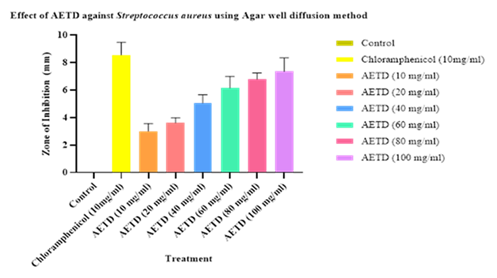
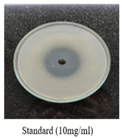
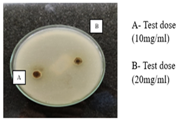
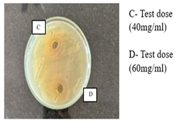
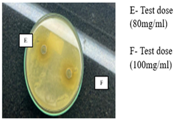
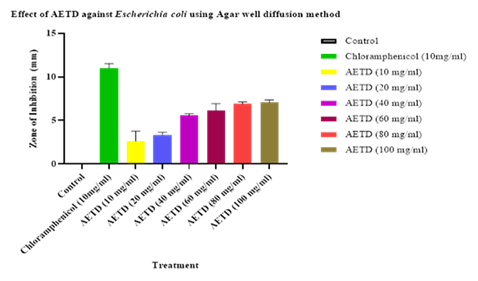
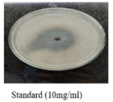
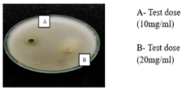
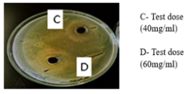
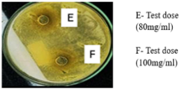
The results of Antibacterial Activity of aqueous extract of Tabernaemontana divaricata (Dwarf) leaves on Staphylococcus aureus and Escherichia coli was shown in Tables 2 and 3 and Figures 1-4.
Table 2. Antibacterial activity of the Aqueous extract of Tabernaemontana divaricata (Dwarf) against S. aureus using agar well diffusion method
|
(mg/ml) |
Bacteria culture medium Zone of Inhibition(mm) (Mean ± SEM) |
|
10 |
3.01±0.5504ns |
|
20 |
3.61±0.3702* |
|
40 |
5.06±0.6083** |
|
60 |
6.15±0.8362*** |
|
80 |
6.97±0.4576*** |
|
100 |
7.36±0.9935*** |
|
Standard drug (Chloramphenicol 10mg/ml) |
8.56±0.928*** |
|
Control |
Nil |
All values are presented as average ± SEM. (n=2), * Indicates the p-value, *p<0.05, **p<0.01, ***p<0.001 between negative control and treated, “ns” indicated not significant.
|
|
|
Figure 1. antibacterial activity of AETDL against S. aureus by agar well diffusion method |
AETDL showed a dose-dependent increase in the zone of inhibition against S. aureus. A lower dose (10mg/ml) showed no zone of inhibition whereas the dose of 60mg/ml-100 mg/ml showed a maximum zone of inhibition that was significantly similar to the standard drug (10 mg/ml).
|
|
|
|
a) |
b) |
|
|
|
|
c) |
d) |
|
Figure 2. Antibacterial activity of AETDL against S. aureus by agar well diffusion method |
|
Table 3. Antibacterial activity of the Aqueous extract of Tabernaemontana divaricata (Dwarf) against E. coli using agar well diffusion method.
|
Concentration of extract (mg/ml) |
Bacteria culture medium Zone of Inhibition(mm) (Mean ± SEM) |
|
10 |
2.61±1.15ns |
|
20 |
3.363±0.27671* |
|
40 |
5.57±0.2134** |
|
60 |
6.135±0.812*** |
|
80 |
6.92±0.225*** |
|
100 |
7.122±0.284*** |
|
Standard drug (Chloramphenicol 10mg/ml) |
11.01±0.5219*** |
|
Control |
Nil |
All values are presented as average ± SEM. (n=2), * Indicates the p-value, *p<0.05, **p<0.01, ***p<0.001 between negative control and treated, “ns” indicated not significant.
|
|
|
Figure 3. antibacterial activity of AETDL against E. coli by agar well diffusion method. |
AETDL showed a dose-dependent increase in the zone of inhibition against E. coli. A lower dose (10mg/ml) showed no zone of inhibition whereas the dose of 60mg/ml-100 mg/ml showed a maximum zone of inhibition that was significantly similar to the standard drug (10 mg/ml).
|
|
|
|
a) |
b) |
|
|
|
|
c) |
d) |
|
Figure 4. antibacterial activity of AETDL against E. coli by agar well diffusion method |
|
Global antimicrobial resistance is on the rise and is associated with an ongoing pandemic that may be overlooked by many. Recent Lancet research reveals that diseases resistant to antimicrobials led to 1.27 million deaths and 4.95 million fatalities worldwide in 2019. Antimicrobial resistance occurs when infectious microorganisms, such as bacteria, viruses, or fungi, develop resistance to medications meant to eliminate them, rendering the prescribed antibiotics ineffective. In India, it is anticipated that sepsis caused by microorganisms resistant to initial antibiotics will result in over 50,000 infant deaths, with a more severe impact on the elderly and newborns. By 2050, antimicrobial resistance is projected to cause over two million deaths in India (Vaou et al., 2021; Sharma et al., 2022; Kun et al., 2023).
Researchers are exploring numerous plants in the field of complementary alternative medicine to identify their antimicrobial properties. Many are actively seeking an alternative therapy that is more specific, safe, and cost-effective for the treatment of microbial infections (Mishra et al., 2014). As the challenge of antimicrobial drug resistance continues to grow, there is increasing uncertainty about their future effectiveness. We must take proactive steps in addressing this issue by exploring the potential of plants. Phytochemicals, naturally occurring compounds in plants, have shown promise in various ways, including their ability to fight against harmful microorganisms (Huang et al., 2022). The unique qualities of phytochemicals can be attributed to specific components within them, such as alkaloids, flavonoids, terpenoids, and phenols (Faramayuda et al., 2024).
The aqueous extract of Tabernaemontana divaricata (Dwarf) leaves exhibited dose-dependent antibacterial effectiveness against S. aureus and E. coli. At 100mg/ml, the zone of inhibition significantly increased (p<0.001), showing similar activity to the standard 10mg/ml (p<0.001) of chloramphenicol. In contrast, the 10mg/ml dose showed no zone of inhibition (ns) compared to the standard Chloramphenicol (p<0.001). These results underscore the promising antibacterial potential of the aqueous extract of Tabernaemontana divaricata (Dwarf) leaves against both bacteria.
Conclusion
The study discovered that the water-based extract of Tabernaemontana divaricata (Dwarf) leaves efficiently fights against both E. coli and S. aureus. Active constituents in the extract, including carbohydrates, alkaloids, flavonoids, tannins, and steroids, contribute to its antimicrobial potency. These phytochemicals are believed to play a crucial role in the observed effectiveness. The results highlight the potential of Tabernaemontana divaricata (Dwarf) leaves as a source of antimicrobial agents. Further research is warranted to fully explore its capabilities.
Acknowledgments: I would like to thank the Staff and Management of Srinivas College of Pharmacy for their Support.
Conflict of interest: None
Financial support: None
Ethics statement: The research involving the collection and analysis of plant material, as well as the antimicrobial testing, was conducted by ethical guidelines and regulations. Proper permissions were obtained for plant collection, and the study adhered to established protocols to ensure the welfare of the subjects involved. The authors affirm that all procedures were carried out ethically and with integrity.
Ahmed, M., Jahan, R., & Rahmatullah, M. (2023). Medicinal plants and their uses by a folk medicinal practitioner of Matlab Upazila in Chandpur district, Bangladesh. Journal of Medicinal Plants, 11(2), 31-38.
Amrita, V., Sonal, D., & Shalini, R. (2009). Antibacterial effect of herbs and spices extract on Escherichia coli. Electronic Journal of Biology, 5(2), 40-44.
Bent, S. (2008). Herbal medicine in the United States: review of efficacy, safety, and regulation: grand rounds at university of California, San Francisco medical center. Journal of General Internal Medicine, 23(6), 854-859.
Bijeshmon, P. P., & George, S. (2014). Antimicrobial activity and powder microscopy of the flowers of Tabernaemontana divaricata R. BR. Indo American Journal of Pharmaceutical Research, 4(03), 1602-1603.
Chinemerem Nwobodo, D., Ugwu, M. C., Oliseloke Anie, C., Al‐Ouqaili, M. T., Chinedu Ikem, J., Victor Chigozie, U., & Saki, M. (2022). Antibiotic resistance: The challenges and some emerging strategies for tackling a global menace. Journal of Clinical Laboratory Analysis, 36(9), e24655.
Doron, S., & Gorbach, S. L. (2018). Bacterial infections: Review. International Encyclopaedia of Public Health, 273-282.
Faramayuda, F., Riyanti, S., Suryani Karmila, S. J., Windyaswari, A. S., & Guntina, R. K. (2024). Extraction time effect on active compounds levels in cat whiskers (orthosiphon aristatus (blume) miq.). International Journal of Applied Pharmaceutics, 16(1), 1-10.
Huang, W., Wang, Y., Tian, W., Cui, X., Tu, P., Li, J., Shi, S., & Liu, X. (2022). Biosynthesis investigations of terpenoid, alkaloid, and flavonoid antimicrobial agents derived from medicinal plants. Antibiotics, 11(10), 1380.
Karimzadeh, I., Alhashemi, S. H., Ghetmiri, S. S., & Vazin, A. (2022). Outcomes of implementing an infectious diseases approval of selected antimicrobials as an antimicrobial stewardship initiative in a referral hospital in Iran. Infectious Diseases in Clinical Practice, 30(1), e1081.
Khameneh, B., Iranshahy, M., Soheili, V., & Fazly Bazzaz, B. S. (2019). Review on plant antimicrobials: a mechanistic viewpoint. Antimicrobial Resistance & Infection Control, 8(1), 1-28.
Kun, F. A. N., Zhang, L., Bangyin, T. A. N., Njateng, G. S., Malong, Q. I. N., Ruirong, G. U. O., Huang, X., Ding, C. F., Weimin, G. A. O., Zhang, R., et al. (2023). Antimicrobial indole alkaloids from Tabernaemontana corymbosa. Chinese Journal of Natural Medicines, 21(2), 146-153.
Mishra, R., Pandey, V. K., & Chandra, R. (2014). Potential of bryophytes as therapeutics. International Journal of Pharmaceutical Sciences Research, 5(9), 3584-3593.
Muteeb, G., Rehman, M. T., Shahwan, M., & Aatif, M. (2023). Origin of antibiotics and antibiotic resistance, and their impacts on drug development: A narrative review. Pharmaceuticals, 16(11), 1615.
Purushothaman, M., Preetam Raj, J. P., Khusro, A., & Panicker, S. G. (2016). Antibacterial activity of Tabernaemontana divaricata (apocynaceae) secondary metabolites capped silver and gold nanoparticles. Asian Journal of Pharmaceutical and Clinical Research, 9(1), 63-5.
Rani, S., Goud, M. P., Kumar, E. U., Nayak, R. L., & Hiranmai, L. (2023). Extraction and evaluation of in vitro anthelmintic activity using nyctanthes arbor-tristis linn. International Journal of Research and Analytical Reviews, 10(2), 485.
Raut, S., Shende, P., Gargate, N., & Kapare, H. (2022). Pharmacognostic and pharmacological aspects on tabernaemontana divaricata plant. Acta Scientific Pharmacology, 3(7), 22-34.
Shaikh, J. R., & Patil, M. (2020). Qualitative tests for preliminary phytochemical screening: An overview. International Journal of Chemical Studies, 8(2), 603-608.
Sharma, M., Walia, K., & Bansal, N. (2022). Unmet needs for management of drug-resistant infections: Low-and middle-income countries’ viewpoint. Drug Target Insights, 16(1), 78-80.
Vaou, N., Stavropoulou, E., Voidarou, C., Tsigalou, C., & Bezirtzoglou, E. (2021). Towards advances in medicinal plant antimicrobial activity: A review study on challenges and future perspectives. Microorganisms, 9(10), 2041.
Wu, Z., Chan, B., Low, J., Chu, J. J. H., Hey, H. W. D., & Tay, A. (2022). Microbial resistance to nanotechnologies: An important but understudied consideration using antimicrobial nanotechnologies in orthopaedic implants. Bioactive Materials, 16, 249-270.