
The consequence of water stress on the polyphenolic content, anticholinesterasic and antifungal activities of methanolic leaf extracts of three Tunisian (Olea europea L.) varieties: Meski, Ouslati, and Jarbouii was investigated. Our results showed that total polyphenolic and flavonoids compounds amplified in all tested varieties under water stress. In addition, water stress increased the anticholinesterasic activity in all all olive cultivars. But Oueslati variety had the best one with the lowest IC50. Antifungal activity of all extracts of olive leaf generally increased under water deficit. We can conclude that water stress exposed positive effect on secondary metabolites; hence the biological effect of olive leaf of different varieties. We can conclude that water stress induced an increase in biological activities (antifungal and anticholinesterasic effects). In addition, Ouslati cultivar may be considered as the most tolerant one, followed by Jarboui and Meski was the most sensitive. Ouslati cultivar may be considered as the most tolerant one, followed by Jarboui and Meski was the most sensitive.
Introduction
Olea europaea L are part of the Oleaceae family and is native to tropical and subtropical regions (Sorkheh & Khaleghi, 2019). It is resistant to water deficit and salinity (Acar-Tek & Ağagündüz, 2020) and its great capacity for adaptation to drought is manifested by morphological and physiological leaf modifications (Boss et al., 2019). The leaf contain high amount of secoiridoid derivatives like oleuropein and oleacein, known by their hypoglycemic and hypotensive effects (Okorie et al., 2019). in Tunisia Olive trees traditionally grow in drought conditions (Edziri et al., 2020). However, responses to stress conditions differ between varieties.
The antioxidant, antimicrobial, cytotoxic, hypoglycemic, antiviral effects of olive leaves have also been investigated (ALHaithloul et al., 2019; Techathuvanan et al., 2019).
According to our knowledge there is no research documenting the impact of water stress on phytochemical composition, anticholinesterasic and antifungal activities of olive leaf extracts. Therefore the goal of this scientific research was to investigate the consequence of water deficit on some morphological parameters, phenolic compounds, anticholinesterasic and antifungal effect of methanolic leaf extracts of three Tunisian olive varieties (Oueslati, Jarboui and Meski).
Materials and Methods
Site Description
The effect of water stress on three Tunisian olive varities (Oleaeuropaea L.) cv. Meski Jarboui and Oueslati were evaluated. three years old olive plantels, were full-grown in greenhouse into 20 dm3pots. During the experience the temperature and humidity were 25/32°C and 65/55%, respectively. for the control plants we used six plants and which are irrigated once a week to the capacity of the field. Further six plants from respectively cultivar devoid of water during May and June by withholding water.
Leaf Morphology and Sclerophylly
The analyses were performed on twenty adult leaves torn from each variety of each cultivar as described by Edziri et al. (2020).
Methanol Extract Preparation
150 mg of desiccated leaves were macerated with 20 mL of MeOH (80 %) for 30 min and shaking at 200 rpm. The extracts were evaporated with rotary vapor after filtration (Edziri et al., 2019) and finally kept at -4°C for biological test.
Determination of Polyphenolic Compounds
The content of total phenolic compounds (TCPT) was determined with the Folin-Ciocalteu reagent (Wang et al., 2022). 100 μl of crude extract or standard was mixed with 500 μl of 10% (v/v) Folin-Ciocalteu reagent. The mixture was placed in the dark for 3 min before adding 400 μl of 7.5% (w/v) Na2CO3. The mixture was incubated in the dark for 30min and the absorbance was measured at 731 nm using a spectrometer. TCPT was expressed as gallic acid equivalent (EqAG)
Determination of Flavonoids Content
To determine flavonoid content, colorimetric method was used as established by Edziri et al. (2020) and it is calculated in terms quercetin equivalent (EgQ) per grame extract.
Evaluation of Acetyl Cholinesterase (AChE) Inhibition Effect
This activity was determined as defined by Ataie et al. (2019), 50 µL of buffer, was mixed with 20 µL of different concentrations of methanolic extracts after that 25 µL of 0.22 U/mL of AChE enzyme was putted. Next 15 min of incubation at 37 °C, we added 30 µL of acetylthiocholine iodide (15 mM AChI) and 130 µL of 5,5’-dithiobis [2-nitrobenzoic acid] (3 mM DTNB) after incubation for 30 min the absorbance was read at 405 nm. IC50 was determined as the concentration of the extract required to inhibit 50% of enzyme
Evaluation of the Antifungal Activity
Fungi
four Candida species; American-Type Cell Culture (ATCC) was used. They are numbered as Candida albicans 90028 (C.a), Candida parapsilosis ATCC 22019 (C.p), Candida glabrata ATCC 90030 (C.g), and Candida kreuseii ATCC 6258 (C.k). Sabouraud agar was used as a cultural medium.
Antifungal Potential
The technique described by Edziri et al. (2020) was used to calculate the essential oils' minimum inhibitory concentrations (MIC). Ten test tubes are required for the dilution procedure, which entails creating a series of tubes with Tryptic Soy Broth (TSB). Nine more tubes hold one milliliter of TSB each, while the first tube holds two milliliters. Subsequently, 20 microliters of an essential oil solution are introduced into the initial tube, and it is diluted to achieve a concentration range of 1 to 0.0039%. Next, 10 μl of the bacterial suspension (final concentration: 107 CFU/ml) is added to each tube for inoculation. The tubes are incubated for 18 hours at 37°C with a control that does not include extract (Moss et al., 2022). The minimum inhibitory concentration (MIC) is the lowest concentration of the essential oil that prevents any growth that is apparent to the unaided eye after 16 to 20 hours of incubation at 37°C.
Statistical Analyses
One-way analysis of variance (ANOVA) was carried out followed
by Dunnett's t-test which is used to test significance (P < 0.05).
Results and Discussion
Leaf Morphology and Sclerophylly
According to Table 1, we can observe that underwater stress decreased LA, SLA, and density, augmented in all tested varieties. We can observe that physiological variations depend on varieties.
Table 1. Morphological parameters of Tunisian olive varieties
|
cultivars |
LA (mm2) |
S (mgH20 cm-2) |
SLA (m2 kg-1) |
D (g kg-1) |
|
Watered |
|
|||
|
Oueslati |
387.1a |
22.13a |
4.42a |
306.3a |
|
Jarboui |
426.3a |
24.55a |
3.14a |
460.2a |
|
Meski |
330.4a |
20.52a |
3.32a |
503.5a |
|
Stressed |
|
|||
|
Oueslati |
321.2b |
29.57b |
4.26b |
280.3b |
|
Jarboui |
312.9b |
27.54b |
2.79b |
410.4b |
|
Meski |
230 .6b |
25.54b |
3.15b |
470.6b |
Values signify the mean of 8 repetitions.
Polyphenols and Flavonoids Contents
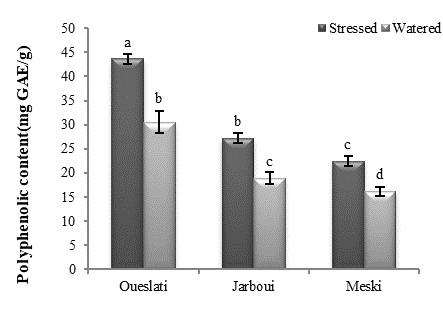
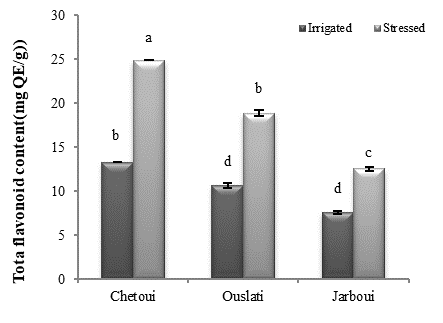
As shown in Figures 1 and 2 Oueslati had the highest phenols contents although Meski had the weakest concentration of polyphenols and flavonoids. Total polyphenols and flavonoid content augmented in all tested varieties. Under water deficit. A greater quantity of phenols was found in the Oueslati variety tracked by Jarboui and Meski.
|
|
|
Figure 1. Polyphenols content of methanolic leaf extracts of Olea europea varieties. Values signify means ± standard deviations for six repetitions. |
|
|
|
Figure 2. Total flavonoid content of MeOH leaf extracts. Values signify means ± standard deviations for six repetitions. |
Anticholinesterase Activity
The acetylcholinesterase inhibitory activity of methanolic extracts of olive leaf varieties was determined by the microplate assay. IC50 values are given in Table 2. As exposed, we can conclude that the oueslati variety had the greatest anticholinesterase activity.
Table 2. IC50 values for acetylcholinesterase (AChE) inhibition of methanolic extracts of olive varieties
|
Methanolic extract of olive varieties |
IC50 (mg.ml-1) |
|
|
|
Stressed |
Watered |
|
Oueslati |
0.10±0.08* |
4.35±0.14* |
|
Jarboui |
0.15±0.08* |
5.76±0.25* |
|
Meski |
0.21±0.05* |
3. 09±0.12* |
|
Physostigmine |
0.04±0.01 |
|
Results are reported as the means ± SE of 6 independent experiments performed in duplicates. *p < 0.05.
Antifungal Activity
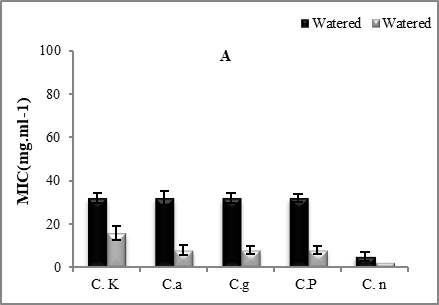
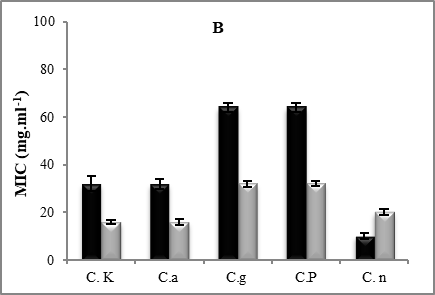
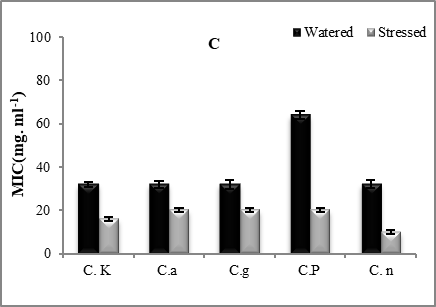
This research work was done to estimate the antifungal activity of methanolic extracts of olive varieties before and under water stress. As shown in Figures 3-5, We can observe that all methanolic extracts of the olive variety had good antifungal activity against all candida species before water stress, with MIC varied between 32 and 64 mg/ml. under water deficit, the antifungal activity increased with all stressed extract varieties. Methanolic extract of the Oueslati variety showed the best activity with MIC values varying between 16 to 4 mg/ml against candida species.
|
|
|
Figure 3. Antifungal activity of methanolic leaf extract of Oueslati a) variety |
|
|
|
Figure 4. Antifungal activity of methanolic leaf extract of Meski b) variety |
|
|
|
Figure 5. Antifungal activity of methanolic leaf extract of Jarboui c) variety against fungi; MIC: minimal inhibitory concentration. |
Trichomes in Olea europea located on the abaxial side of the leaf, have the role of protecting stomata from UV rays and preventing dehydration (Moss et al., 2022). According to these results, Oueslati leaf has a higher density of stomata and trichomes than the other variety.
We see that the lack of water has decreased in the three varieties, the Oueslati variety seems best adapted to drought thanks to its smaller leaves. On the other hand, smaller sheets allow better control of heat dissipation and minimize water loss through stomata closing. The decrease in the surface area of the leaf is a defense mechanism to avoid dehydration and allows the plant to better resist the lack of water.
The decrease in SLA observed in the leaves of plants subjected to water stress is explained by the difference in density of the leaf (Wang et al., 2022). ‘Oueslati’ had the lowest density. The Meski cultivar showed the lowest values. which shows that this cultivar is more sensitive to drought conditions than other varieties.
The production of Reactive Oxygen Species (ROS) in the chloroplast is one of the first biochemical responses of cells in response to water stress. In this context, photosynthesis is reduced, the plant can no longer use the excess energy provided by light and oxidative stress will occur. There is a production of ROS, by-products of oxygen metabolism (oxygen O2- ions. OH free radicals, H2O2 peroxides), which will trigger a process aimed at eliminating active oxygen species (Boss et al., 2019; Deng et al., 2019).
Inhibition of AChE is a treatment strategy against several neurological disorders like Alzheimer's disease (Edziri et al., 2012). The methanolic extract of Oueslati variety olive leaves was found to be the most active against acetylcholinesterase during water stress with an IC50 of 0.1 mg/ml. These results confirm well with those described in other research work (Kachoie et al., 2012; Edziri et al., 2019).
We can see that the observed differences in the antifungal effects of olive leaf varieties can be associated with their geographic location, and environmental conditions (Abidi et al., 2019). The response of the plant to environmental conditions and more particularly to water deficit, which is the most limiting stress on growth, has an impact on leaf structure. It differs depending on the nature and duration of stress (Ganjalikhan et al., 2019). But this research work is in accordance with the work of Kachoie et al. (2012) that confirmed the importance of antimicrobial potential against gram-positive and negative bacteria of the Thymus diagenesis extracts which increased (1000 µg/ml) under water deficit. Leaves may be thicker due to an increase in the thickness of the mesophyll and cuticles, with an increase in dry matter content per surface area and unit of volume (Wang et al., 2022).
In this work, the comparison of the antifungal activity of these three olive cultivars proved that the antifungal activity increased in all olive cultivars in case of water deficit. this increase may correlate with the high polyphenol content as has been described in other research works (Edziri et al., 2019; Wang et al., 2022). But this research work is in accordance with the work of Kachoie et al. (2012) that confirmed the importance of antimicrobial potential against gram-positive and negative bacteria of the Thymus diagenesis extracts which increased (1000 µg/ml) under water deficit.
Leaves may be thicker due to an increase in the thickness of the mesophyll and cuticles, with an increase in dry matter content per surface area and unit of volume (Wang et al., 2022).
Conclusion
In conclusion, our study can be considered as the first report on the impact of water stress on antifungal and anticholinesterasic activities of Oueslati, Meski and Jarboui olive varieties. Our results demonstrated that water stress affects the physiological and biological criterion of Tunisian olive varieties. Oueslati variety appears the most adapted variety to drought and possess the best antibacterial and anticholinesterasic effects, followed by Jarboui and Meski. This research will be continued in a future in other Tunisian varieties, to have an idea of other varieties and their mechanism of tolerance to water stress and their biological activities in the face of other stress factors.
Acknowledgments: None
Conflict of interest: None
Financial support: None
Ethics statement: None
Abidi, A., Bahri, S., Ben Khamsa, S., & Legrand, A. (2019). A comparative study of intratracheal and aerosolization instillations of bleomycin inducing experimental lung fibrosis in rat. Toxicology Mechanisms and Methods, 29(2), 75-85.
Acar-Tek, N., & Ağagündüz, D. (2020). Olive leaf (Olea europaea L. folium): Potential effects on glycemia and lipidemia. Annals of Nutrition & Metabolism, 76(1), 10-15.
ALHaithloul, H. A. S., Alotaibi, M. F., Bin-Jumah, M., Elgebaly, H., & Mahmoud, A. M. (2019). Olea europaea leaf extract up-regulates Nrf2/ARE/HO-1 signaling and attenuates cyclophosphamide-induced oxidative stress, inflammation and apoptosis in rat kidney. Biomedicine & Pharmacotherapy = Biomedecine & Pharmacotherapie, 111, 676-685.
Boss, A., Kao, C. H., Murray, P. M., Marlow, G., Barnett, M. P., & Ferguson, L. R. (2016). Human intervention study to assess the effects of supplementation with olive leaf extract on peripheral blood mononuclear cell gene expression. International Journal of Molecular Sciences, 17(12), 2019.
Deng, B., Fang, S., Shang, X., Fu, X., & Yang, W. (2019). Influence of genotypes and environmental factors on leaf triterpenoid content and growth of Cyclocarya paliurus. Journal of Forestry Research, 30(3), 789-798.
Edziri, H., Haddad, O., Saidana, D., Chouchen, S., Skhiri, F., Mastouri, M., & Flamini, G. (2020). Ruscus hypophyllum L. extracts: Chemical composition, antioxidant, anticoagulant, and antimicrobial activity against a wide range of sensitive and multi-resistant bacteria. Environmental Science and Pollution Research International, 27(14), 17063-17071.
Edziri, H., Jaziri, R., Chehab, H., Verschaeve, L., Flamini, G., Boujnah, D., Hammami, M., Aouni, M., & Mastouri, M. (2019). A comparative study on chemical composition, antibiofilm and biological activities of leaves extracts of four Tunisian olive cultivars. Heliyon 5, e01604
Edziri, H., Jaziri, R., Haddad, O., Anthonissen, R., Aouni, M., Mastouri, M., & Verschaeve, L. (2019). Phytochemical analysis, antioxidant, anticoagulant and in vitro toxicity and genotoxicity testing of methanolic and juice extracts of Beta vulgaris L. South African Journal of Botany, 126, 170-175.
Edziri, H., Mastouri, M., Aouni, M., & Verschaeve, L. (2012). Polyphenols content, antioxidant and antiviral activities of leaf extracts of Marrubium deserti growing in Tunisia. South African Journal of Botany, 80, 104-109.
Ganjalikhan Hakemi, S., Sharififar, F., Haghpanah, T., Babaee, A., & Eftekhar-Vaghefi, S. H. (2019). The effects of olive leaf extract on the testis, sperm quality and testicular germ cell apoptosis in male rats exposed to busulfan. International Journal of Fertility & Sterility, 13(1), 57-65.
Kachoie, M. A., Pirbalouti, A. G., Hamedi, B., Borojeni, H. R., & Pishkar, G. R. (2013). Effect of drought stress on antibacterial activity of Thymus daenensis subsp. daenensis Celak. Journal of Medicinal Plants Research, 7(36), 2923-2927.
Moss, B. J., Ryter, S. W., & Rosas, I. O. (2022). Pathogenic mechanisms underlying idiopathic pulmonary fibrosis. Annual Review of Pathology, 17, 515-546.
Okorie, V. O., Mphambukeli, T. N., & Amusan, S. O. (2019). Exploring the political economy of water and food security nexus in BRICS. Africa Insight, 48(4), 21-38.
Sorkheh, K., & Khaleghi, E. (2016). Molecular characterization of genetic variability and structure of olive (Olea europaea L.) germplasm collection analyzed by agromorphologicaltraits and microsatellite markers. Turkish Journal of Agriculture and Forestry, 40(4), 583-596.
Techathuvanan, C., Reyes, F., David, J. R., & Davidson, P. M. (2014). Efficacy of commercial natural antimicrobials alone and in combinations against pathogenic and spoilage microorganisms. Journal of Food Protection, 77(2), 269-275.
Wang, L., Zhu, T., Feng, D., Li, R., & Zhang, C. (2022). Polyphenols from Chinese herbal medicine: Molecular mechanisms and therapeutic targets in pulmonary fibrosis. The American Journal of Chinese Medicine, 50(4), 1063-1094.